Tuesday, May 10, 2011

What's going on with E-Mate 2011. Check it out


On Sunday 24th April 2011 was the centenary anniversary of National Tsing Hua University. NTHU International volunteer from Ghana, Tanzania, Nepal, Indonesia sold some souvernirs for the fundraising.

5th generation of E-Mate sold some Indonesian cuisine such as fried noodles, chilly sauces, snacks and lychee beverages. All of the food was fresh prepared by Taiwanese Students. Two thumbs up for E-Mate

E-Mate team had group discussion and bahasa course weekly. Honda Gan is the teacher for the Bahasa course. He is a cute boy from Malaysia and had joined E-Mate to Aceh for 3 times.

Recently E-Mate volunteer is discussing their program, mission, schedule and the challenges.

New challenges for E-MAte is Ramadhan/ fasting month for Muslim. This could be interesting experiences and new learning for E-Mate, they can observe Muslim in Indonesia pass the fastings and lifehabits.

With "Go green " as E-Mate tagline this year. They will establish recycle station in Sabang and donate dustbins. Instead of doing recycle process, E-Mate will do sweeping around Unsyiah's campus and Sabang city. E-Mate hopes this can be the example for Acehnese people and can attract the mass media. This year, E-MAte will also visit Blangkejeren to make video about Coffee and Gayonese cultures

Wednesday, May 4, 2011

Amazing Forum and sharing from Tanzania, Indonesia, Ghana and Nepal

NTHU Overseas Service Learning Program 2011 Review & Prospect Forum
On Sunday (1st May) National Tsing-Hua University hold Overseas Service Learning Program 2011 review & prospect forum which is one of the series activities of CENTENARY CELEBRATION. NTHU invite the local cooperators from 4 international volunteer groups (Nepal, Indonesia, Ghana, and Tanzania) to celebrate the centenary of NTHU together.

The purpose is to give thanks to the cooperators for their kind assistances over the past four years and review the voluntary projects over the past four years with students and foreign partners.

The interaction between students and local cooperators was really enthusiastic. The most interesting question is " which one you prefer if we simply donate all the money to the volunteering country or send the students to serve in your county? " Tanzania cooperators said "send the money to our country is useless, it is better if NTHU students can come to Tanzania and bring the people knowledge, experiences, volunteering experiences and this will teach people the capacity to find their own money"

Tuesday, March 15, 2011

Indonesian Culture Exhibiton 2011


Indonesian Culture Exhibition 2011 was held from March 10 th – 11th, 2011 at the National Taiwan University of Science and Technology, Taipei.

The event was organized by Indonesian Student Association at National Taiwan University of Science and Technology ." We want to promote Indonesian Culture to Taiwanese and experience the diversity “said Citra, President of NTUST-ISA. Staged annually, The Exhibition was once again a great success and more exciting, educative and diverse than ever before. More than 1000 visitors attended the fair.

Bamboo Community University Association ( BCUA) as one of Co-Host of the Event presented African Drum performance. Aiming to give visitors cross culture experiences and attract many visitors from different ages. "Even just a short show but visitors can learn how to play a simple song and feel the exciting beats and rhythms of the African Drums" said Nick Lee, BCUA project manager.

BCUA started a strong partnership with Indonesian NGOs and Universities after Aceh Tsunami in 2004. We recruit volunteers from National Chiao Tung University known as I-DO Volunteer Team and National Tsing Hua University known as E-Mate Volunteer Teamto serve in Indonesia. E-Mate team which will go to Aceh this summer 2011 for volunteer project focus on ICT development, Gayonese Culture and Fair Trade Coffee also came to the Exhibition to know more about Indonesia and meet Acehnese student in NTUST. While I-DO which focus on Indonesia rain forest and Orangutan conservation came to the Event for fundraising and try to promote their project in Indonesia.

Traditional dishes, games, cultural wedding dressings and wood cravings as well as household utilities and ornaments were presented in different features. The cultural folk dance accompanying the opening and closing ceremony brought memories for many visitors.


Sunday, January 16, 2011

5th E-Mate International Volunteer


E-Mate is long term volunteer project between BCUA and NTHU .First E-Mate started in 2007 and now the 5th project is still going on .E-Mate volunteer is focusing on Aceh, northern Sumatra Island of Indonesia. After devastating Tsunami and 9.0 magnitude earthquake hit Aceh in 2004 .

In summer 2011, There are 9 new volunteers from National Tsing Hua University ,
a leading technological university in Taiwan will hold 5th E-Mate workshop. NTHU will also invite 2 representatives from Aceh to Taiwan in the end of April 2011. The main purpose is to strengthen the relationships , experience sharing of E-Mate contribution on Aceh ,and expertise development

The workshop contains 3 sections . 1st is IT section in which implement free software to local university students and teachers such as Ubuntu , Open office ,GIMP , Google earth . 2nd is Environmental section focus on waste management in Takengon, Central Aceh. 3rd is Culture and innovation section focus on Digital archieve learning which is Gayo traditional performance and Acehness coffee bean fieldtrip.

Check it out 2010 E-Mate volunteer


Local Community Development

Meeting on 香山project picture

It’s almost 3 weeks I have been working in BCUA starting from 28dec 2010 . Many new things happen around luckily I can easily adapt to my working environment of course with support from colleagues. 3 weeks pass superb fast !! On Monday , 10 Jan 2011 we had meeting in香山church , Hsinchu . The Keynote speech was given by Synic Mj. Her presentation gives description of BCUA New Project focusing on香山Community Development .

One of Taiwan indigenous people , Naluwan Amis Tribe (那魯彎) who lives in XiangShan area (香山) is facing culture changes and environmental pollution issues . Is it fair thatHsinchu Science Park which is now one of the world's most significant areas for semiconductor manufacturing has enjoyed the fastest growing economic profit while the indigenous people have suffered from various forms of pollution ?

Most of the Industrial waste will end up in the river and waterland (
香山溼地) where the Amis lives.The Amis are primarily fishermen due to their coastal location . “ Past industrial pollution data and research paper about (Xiang Shan waterland)香山溼地will be valuable to move forward “ said Prof Lee from Humanity and Social Science department in National Tsing Hua University

I strongly believe that the damage that will occur in certain areas will have an impact not only to the local community, but Taiwan as a whole, because that is the law of nature. People in big cities in Taiwan, should be able to see this as a threat that can suppress the identity of Taiwan. It is clear that present generations is forgetting that what now exists is borrowing from future generations


We hope that this program will open the eyes of the Taiwan government and see the strengths and efforts of local communities in protecting their assets, develop the understanding that the indigenous people of Taiwan for the sake of future generations in Taiwan too .

Look at the beauty of Amis indigenous


.


Monday, January 10, 2011

Another story of Synic Mj

Another story of Synic Mj , The Vice Director Of BCUA who has been working in NGO for 11 years and actively engage in relevant field such as E-Mate volunteer team , environmental issues and community development program . In October 2010 , Synic got the opportunity from MOFA Taiwan to do internship in Sumatran Orangutan Society (SOS) in England

Helen Buckland (Left ) , Synic Mj (Right)
Synic was impressed a lot by the lovely Bruce - 8 years old rescued dog

The most special point that Synic found out from SOS was that their operation expense is mostly generated from fundraising and sponsorship . For instance 2010 Elephant Parade
which was the biggest public art exhibition ever to be staged in London , to raise funds for the conservation of Asian elephants. Orangutans and elephants face the same fate from the destruction of the Sumatran rainforest


Indeed , I was impressed by audience’s enthusiasm and curiosity during 90 minutes Synic’s experience sharing . She also found that Taiwan also has successfully raise fund for disabled people . You can see almost every corner of Taiwan convenience store provides charity box to help disabled people . In the future , Synic hope that Taiwan can also raise fundraising program to save endangered species .

Here are some debatable questions from audience
1. Does this fundraising program pays off ? Do Indonesian local government really cares about this conservation projects issues ?
2. How can SOS successfully raise public awareness of the endangered species threats and assure the local society that this fund go to the right place ?


I must say this program is worth going !! Can you imagine what happens if rainforest gone? You no longer can smell the fresh oxygen. My opinion on 2nd question is : you must have good public awareness power , you can use media mass to make your voice heard. Make society aware of the power they have to make a difference. what we can do to take action on the issue.


Monday, January 3, 2011

Volunteer has no boundary


National Chiao Tung University Service Learning Center offers two international volunteer program to Indonesia and India which will take place in summer 2011. Are you mentally and emotionally ready to challenge yourself in this volunteer program ?

No reason to miss it !!!!
The registration deadline : Jan 28 2011 (Friday )
http://service-learning.nctu.edu.tw/news_1.php?nid=99

International Volunteer Preparation
Collaboration and expertise sharing is essential step in training period .Both Team can :
1. Working together in one team
2. Cooperate in Basic Volunteer Training
3. Naluwan Aboriginal Workshop
4. Social learning and community development program
5. Experience sharing from previous volunteer: I-DO , E-Mate , Ghana Team


NCTU Indonesia Volunteer ( I-DO )
Are u ready for the Next I-DO ?
Indonesia Volunteer program is on its second year. The 1st volunteer took place 15 July -29 July 2010 which 12 volunteers from NCTU held a camp in Bukit Lawang, Indonesia. The name of the camp is I-DO CAMP which merges Information , Digital and Orangutan . We hope to empower the local community to use technology to further ecotourism. Sustainable tourism is crucial to the wellbeing of the local ecosystem and community, providing an alternative to unsustainable logging and palm oil plantations.

The first Indonesian Volunteer program ran successful under the collaboration of BCUA , OIC and NCTU. Meanwhile The second volunteer program to Indonesia is mainly focus on ecotourism promotion , renewable energy program , community empowerment . It's particularly important in Bukit Lawang because many of Sumatra’s critically endangered orangutans live here, including some that have been rehabilitated and returned to the wild. The park forms part of Gunung Leuser National Park, recognized by UNESCO as a biosphere reserve and World Heritage Site, which holds the dubious nickname of “Last Stand of the Orangutan.”

Check it out what they said about Volunteering


NCTU India Volunteer
What can volunteer do for Jamyang School Ladakh ,India ?

India is the new international program and focus more on education and environmental improvement. It’s located in Jamyang School Ladakh , India . Jamyang school is remote area in Himalayan areas. All admitted children come from the poorest families of the villages with predominantly difficult family backgrounds: divorced family , orphan , unemployment family and society who live in poverty.
After completi
ng their studies, these women will serve as teachers, health care workers, community workers, and mentors to others. They will create similar study programs in their homelands and other needy areas. They will be able to help their people and help revitalize their special cultural heritage.

Monday, November 1, 2010

The fundraising models of NPOs and Foundations in Taiwan.

1 Abstract

In 2006, Taiwan government released the "Charity Donations Destined For Social Welfare Funds Implementation Regulations" for the following main purposes, effective control of Charity Donations, to use societal resources in appropriate manners, to promote social welfare & to protect the rights of donors.

However, due to the flaws and incompleteness of the regulation for a long time, in 2005, some NPOs advocated to establish the Taiwan NPO Self-Regulation Alliance to enhance the NPO accountability and transparency for the public.

According to the thesis of 歐烱杕, it shows that most Taiwan NPOs funding are form donation and government grants, and most NPOs lack confidence to ask enterprises to give. To make people abroad know about Taiwan NPOs found raising models, of which I will make analysis report on three NPOs with different know-hows. "Genesis Social Welfare Foundation" is good at Government Uniform Invoice (GUI) fundraising from the public, "Sunshine Social Welfare Foundation" which demonstrates how NPO could cooperate with small and medium-sized enterprises in Taiwan and "United Way of Taiwan" which adopts Liverpool Charity and Voluntary Services and acts as the mediation to raise, distribute and monitor fund for NPOs and as the platform to meet the needs and interest of minority people, NPOs and enterprises in Taiwan.

According to my literature review to their websites, the way for the public to give and the NPOs to raise fund in Taiwan are very creative and convenient now. People now would like to give by credit card more than before. In chain stores, you could easily print out the donation voucher from multimedia kiosk or just give changes or invoices for donation. To dial up a quick call with your cellphone is accessible to everyone who wants to give.

The E-funding system is easy to access on NPO's websites. Retrieved from The SSWF website.

Follow steps on ibon at 7-11 to print out the donation voucher. Retrived from: http://www.tfrd.org.tw/help/index.php?kind_id=1&sid=37

It is also important to have fans and supporters in virtual reality for NPOs. It is a shame not to use the web 2.0 applications like Facebook, Plurk and Blogger to promote the campaigns and organize fans for bigger social effects. Some fancy ways to raise funds, such as to fulfil friends' birthday charity wishes by donation or just married couples to buy charity thank card for friends, are integrated with the web 2.0 platform to engage young generations as well.

The Birthday Donation on the United Way of Taiwan Website and from which you could see how many friends support your birthday charity wishes and how much they have donated for you. Retrieved from The United Way of Taiwan.

There are some famous commercial portal sites like "Yahoo Charity" which functions like "Virgin Money Giving" in UK and the Apple Daily Charitable foundation, endowed from a famous gossip media cooperate, engage their numerous audience and readers to participate in donation and caring for the charity events.

This is one of the Sunshine Social Welfare Foundation's charity program on Yahoo Charity. You could see who are the donors to this program and how much money the foundation have raised. Retrieved from The Yahoo Charity website.

You could be a donor on Yahoo Charity. The page shows that this donor who has donated a lot of charity programs listed below. Retrieved from The Yahoo Charity website.

According to many studies, exposures to individual fundraising case are very effective for raising people's attention and sympathy in Taiwan, however people also criticises that the media power will mislead the public and result in unfairness of benefit distribution to the general cases. The NPOs and the endowment cooperation which care for the disabled people have very successful fundraising performance in Taiwan. It shows us that people prefers to give emergency donation or give money with soon and visable outcome.

According to Taiwanese' cognition, that we want to promote the orangutan conservation and rainforest their home is kind of like "a long-term overseas relief-aid case". We could hold fundraising activities which are legal in law and regulations but probably challenging for people's awareness. I suggest that the most important thing is to raise people's awareness to the world diversity and global warming change with linkage to the cause of orangutan extinction and their home rainforest devastation. Still, some cooperation could be made among the conservation and environmental protection NPOs, linked with zoos which keep endangered spices and implementing the platform of communities universities in Taiwan which are regarded the most successful social civilization movement in the last decade.

I must say that it is a unusual case for Taiwanese to donate money to aid overseas conservation work for a long time compared with the relief cases such as Tsunami 2004, Sichuan earthquake 2008 and Haiti earthquake 2010, however if we could successfully raise Taiwanese' awareness and contribute global obligation, this could be the initiative action for Taiwanese to aid the conservation work overseas.


2 Case studies to the fundraising models of NPOs in Taiwan


2.1 Taiwan NPO Self-Regulation Alliance


2.1.1 Website portal

  1. Taiwan NPO Self-Regulation Alliance (English)
  2. 台灣公益團體自律聯盟 (Mandarin

2.1.2 Objectives

Established in 2005. Their main objectives are to establish a self-regulation mechanism to promote information disclosure by NPOs, strive for the protection of donor rights, promote a legal environment that will ensure the sound development of Taiwan's NPO sector, encourage exchange between NPOs and promote NPO-related research.

2.1.3 Accountability

It provides the website to regulate NPOs who sign the pledge to updates their financial reports annually.

2.2 United Way of Taiwan

2.2.1 Website portal

  1. United Way of Taiwan(English)
  2. 中華社會福利聯合勸募協會 (Mandarin)

2.2.2 Objectives

Established since 1992. The United Way adopts the model of the Liverpool Charity and Voluntary Services in UK and acts as the platform and mediation to raise, distribute and monitor the fund and resources for NPOs in Taiwan.

2.2.3 Fundraising

In 2009, the United Way raises around $14 million from the public. According to their regulation, 85% of the raising funds will be distributed reasonably to NPOs after cautious evaluation to their performance and accountability by the committee, 2% will be the saved as the emergency relief fund, and 13% will support the administration of the United Way.

2.2.4 E-Funding system

People could transfer money through credit card, post office, banks and by check. People could also use the Multimedia Kiosk in chain stores, like the ibon of 7-11, Famiport of FamilyMart and LifeET of Hi-Life to print out the donation voucher and pay at the store counter. Also, the cellphone quick call is accessible to anyone who wants to give.

The United Way of Taiwan cooperates with patrons and celebrities to encourage young people to join the Birthday Donation and Wedding Donation activities which are integrated in web 2.0 application system.

The United Way of Taiwan has a portal site on Yahoo Charity and has a very good performance in fundraising for their programs.


2.2.5 CSR

The United Way of Taiwan has long term relationship with Citi Bank and has the permission from government to put donation boxes at the chain stores. Some enterprises also encourage their employees to donate one-day salary.

Many enterprises which want to contribute to the social welfare affairs but has no specific target will choose to donate to the United Way of Taiwan and trust their management of donation.


2.3 Genesis Social Welfare Foundation


2.3.1 Website portal

  1. Genesis Social Welfare Foundation(English)
  2. 財團法人創世福利基金會(Mandarin)

2.3.2 Objectives

Established in 1987. Their main objectives are to care for patients of persistent vegetative state (PVS), the elder and the homeless.


2.3.3 Fundraising

GSWF has the authority form government to put GUI donation boxes in schools, supermarkets (Carrefour) and chain stores (7-11, FamilyMart, HiLife) and will collect GUI boxes to check reward regularly.

According to the website, JSWF collected almost 100 million of GUI throughout Taiwan in 2009 and after checked by volunteers and staffs, they got the reward prize of around $3 million.


2.3.4 E-Funding system

People could transfer money through credit card, post office, banks and by check. People could also use the Multimedia Kiosk in chain stores, like the ibon of 7-11 or Famiport of FamilyMart to print out the donation voucher and pay at the store counter.

It provides sticker code for blog writer to post campaign news, organizes Facebook, Twitter and Plurk fans and produces animations and videos which are cooperated with celebrities and politicians to encourage GUI donate.

JSWF has no portal site on Yahoo Charity.


2.3.5 Accountability

Every 2 months, JSWF publishes the newsletter to their members and update on the website about their income, expense, donors' information and also reward price of GUI, however people can not find their annual financial reports like "Sunshine Social Welfare Foundation" online or on NPO Self-Regulation Alliance's website.

JSWF has the online search engine for donors to keyin their names to know if JSWF updated the donation or not.


2.3.6 CSR

JSWF which is famous and large foundation in Taiwan has very good relationship with small and medium-sized enterprises which will search for cooperation with them directly.


2.4 Sunshine Social Welfare Foundation


2.4.1 Website portal

  1. Sunshine Social Welfare Foundation(English)
  2. 陽光社會福利基金會(Mandarin)

2.4.2 Objectives

Established in 1989. Their main objectives are to provide an extensive range of services for burn survivors and people with facial disfigurement, to assist them in their physical, psychological and social rehabilitation and to uphold their human rights and dignity.


2.4.3 Fundraising

Except the GUI donation, the SSWF cooperates with many small and medium-sized enterprises to promote their campaigns and donation activities like "One NTD one person", selling the charity products and so on.

From the donation list on the website, you can see many donors are small and medium-sized enterprises and 23 enterprises of them provide job opportunities for burn survivors.


2.4.4 E-Funding system

People could transfer money through credit card, post office, banks and by check. People could also use the Multimedia Kiosk in chain stores, like the ibon of 7-11 or Famiport of FamilyMart to print out the donation voucher and pay at the store counter.

It provides sticker code for blog writer to post campaign news and organizes Facebook, Twitter and Plurk fans.

The SSWF has a portal site on Yahoo Charity and has a very good performance in fundraising for their programs.


2.4.5 Accountability

The SSWF updates their annual financial report in details and donors' information on website.


2.4.6 CSR

The SSWF cooperates with small-medium sized enterprises to provide job opportunities and scholarship for burn survivors and encourages enterprises to buy their merchandise, to donate GUI and to promote campaigns together.


3 References

  1. Regulations
    1. Charity Donations Destined For Social Welfare Funds Implementation Regulations(English)、公益勸募條例(Mandarin)
    2. Charity Donations Act - Implementation Regulations(English)、公益勸募條例施行細則(Mandarin)
    3. Charity Donations Destined For Social Welfare Funds Implementation Regulations - Permission Regulations(English)、公益勸募許可辦法(Mandarin)
  2. Thesis
    1. 歐烱杕(民97)。錢從哪裡來:台灣非營利組織之社會資本研究 (碩士論文)。 取自http://etd.library.scu.edu.tw/ETD-db/ETD-search-c/view_etd?URN=etd-0905109-104633
  3. NPOs transparency and accountability advocacy associations
    1. Taiwan NPO Self-Regulation Alliance (English)、台灣公益團體自律聯盟 (Mandarin)
  4. Case studies to NPOs fundraising models
    1. UnitedWay of Taiwan(English)、中華社會福利聯合勸募協會 (Mandarin)
    2. Genesis Social Welfare Foundation(English)、財團法人創世福利基金會(Mandarin)
    3. Sunshine Social Welfare Foundation(English)、陽光社會福利基金會(Mandarin)

Tuesday, October 26, 2010

The legal environment of the endowment cooperation and the NPO in Taiwan

1. Definition

According to the Civil Code, the juridical persons are divided into two categories, one is for profit and the other is not for profit. Non-Profit juridical persons could be divided into the Endowment Cooperation / Foundation and the Non-profit Organization.

In the following report, I would like to analyse the difference in law or regulations and report on the advantage and disadvantage between the Endowment Cooperation / Foundation and the Non-profit Organization.

s. I will refer Endowment Cooperation as the Endowment Cooperation / Foundation and refer NPO as Non-profit Organization.

2. Background

If you would like to establish a NPO in Taiwan, you must follow the Civil Associations Act, however if you intend to establish a endowment cooperation, you must check your business category, running at a national, municipal or city level and follow the related regulations stipulated by different government departments which always require the endowment asset (including property and funding) up to $10 to 30 million at national level and $60 to 200 thousand at municipal or city level.

For a NPO, at least with 30 initiators who are over 20 years old and following some simple procedures, it is easy to establish one.

Both must register in local court wherever their business runs to get the juridical position.


3. Comparison table

The comparison of the Endowment Cooperation and the NPO by law in Taiwan


4. The strength and flaws of the Endowment Cooperation

In general, endowment cooperation is more stable than NPO with reasons as bellow,

  1. The endowment cooperation owns endowment asset but only the interest of it could be used for the social welfare purpose. If the board member could manage the assets properly, their financial condition is better.
  2. The power is controlled by the board members not like NPO whose policy is made by the public will. Besides, the chairman of the foundation could be reelected as long as the board members think he or she is qualified to manage the asset properly.
  3. Accountability is very important for endowment cooperation cause they must manage a big number of asset and donation.

But, there are some flaws or constrains to it,

  1. You must invest a lot of asset and not many NPOs can transform into endowment cooperation easily.
  2. You must invite famous or powerful patrons to increase the exposure for raising donation form the public.
  3. It could be very dominated by family members or small group of people whose management could result in bad reputation or exclusive to the outsiders.
  4. Sometimes, the power is controlled by whose endowment asset is more than others.

5. The threats and challenges to NPOs in Taiwan

The chairman can only be reelected once after expired office term for 3 years and the important policy must be decided by the members voting. It could lead to the instability of the association however you could also take it as a more democratic and open running model.

It is a common phenomenon that most NPOs' funding is from government grants which are restricted funding, not much for staff salary expense. With the restricted funding, NPOs are forced to do something which is not necessary meeting their vision or mission to survive. Some people criticizes that NPOs become the government's broadcasting system, follow their will and loose position to monitor them.

But, there is another voice addresses that the government is not capable of everything, if NPOs are eligible to provide professional services and represent as the grass-root power of the community, it could be a mechanism of collaboration and partnership between the government and NPOs.

Accountability is very important for NPOs too. Even NPOs apply for grants from government who always require accountability of the grant under the pressure of legislators. However, the budget relocation and low salary for staffs are also threats for NPOs in Taiwan.

6. Conclusion

In Taiwan, if you want to establish a sustainable organization, to establish a NPO could be the short term goal and a cooperation as the long term vision.

However, to make your organization sustainable not only depends on endowment asset insurance but also a democratic body to engage the public, accountability, project management, communication and outreach, raising funds and public awareness, etc. To pursuit for professionalism is a lesson that the endowment cooperation and the NPOs in Taiwan should continue to learn.

7. References

  1. 全國法規資料庫(Mandarin)、Laws & Regulations Database of the Republic of China(English)
  2. Civil Associations Act (「人民團體法」英文版)
  3. NPO法規介紹–財團法人許可登記及監督(連結全失效,大部分要點或準則已廢除)
  4. 行政院環境保護署審查環境保護財團法人設立許可及監督要點(97.08.26.)
  5. 「教育部主管教育事務財團法人設立許可及監督準則」
  6. 新竹市教育事務財團法人設立許可及監督準則
  7. 新竹市文化藝術財團法人設立許可及監督準則
  8. 臺北市財團法人暫行管理規則
  9. 臺北市政府社會局主管業務之財團法人設立許可及監督輔導管理補充規定
  10. 全國性人民團體數
  11. Culogy:非營利組織行政管理讀書會講義-什麼是NPO/NGO組織?,葛皇濱

Jane Goodall Institute Taiwan Analysis

1. Background

JGI had established the Taiwan branch in 1996 which is the 19th branch in Asia. The most significant achievement has made is that JGI Taiwan have invited JG to Taiwan over 10 times and facilitate more than 500 "Roots & Shoots" school groups in Taiwan.

According to the mandarin title of JGI Taiwan, 國際珍古德教育及保育協會中華民國總會 is a NGO rather than a foundation which is stipulated by a more accountable law in Taiwan.


2. Fundraising and Sponsorship Models

Jane Goodall is very famous in Taiwan, so it is smart to invite her once a year for 3-4 days to raise funds and public awareness.

During JG's stay in Taiwan, she will join the fundraising party, Zoos visit, the Wild Make-Up Parade, "Roots & Shoots" groups meetings, deliver speeches in schools and universities, and visit to the indigenous tribe which has built up relationship with her for a long time.

Some income of JGI Taiwan is from membership and there are 3 kinds of them, individual member (20 pounds/year), student member (10 pounds/year) and group member (100 pounds/year). Like most charities, they also sell merchandise including JG's books, calendar, VCD/DVD, children's book, T-shirts, and etc.

There are many company donors, according to the website, however I don't actually know to what companies have gave. This kind of CSR could be very bluffing in Taiwan. Sometimes companies just support their service or product once to us and we could put their logo or links in the CSR page for a long time.

JGI Taiwan mentions in website that most of their funding raised will be used to support "Roots & Shoots" program, which is a humanitarian and conservation education program, rather than JGI's field work in Africa or academic research in Chimpanzees.

E-funding system is not popular in Taiwan, only transferring money or faxing the credit card info allowed to make a donation as mentioned in JGI Taiwan's website.


3. Communication and Outreach

Facebook and Blog which are not well organized and active.

There are 3 kinds of newsletter in the website, including news about environment and eco-life which most is quotation of JG's books or speeches or citation of environment news in Taiwan's newspaper, news about "Green Thumb" Program and "Roots & Shoots" Program.

4. Conclusion

According to the mandarin title of JGI Taiwan, it is the branch of JGI as a legal NGO. In Taiwan, registered NGOs and foundations are allowed to receive donation and sell merchandise to the public.

For JGI Taiwan, their public awareness is not limited to Chimpanzee issues but also the wild and environmental conservation practice in schools and communities. It's a broader and more acceptable advocacy in Taiwan since that Chimpanzee is not a native spice and Taiwan people will doubt that why makes donation to support the program in Africa.

As you can see that the JGI Taiwan's target audience is the "young people" mainly in primary schools and they facilitate young people with the "Roots & Shoots" Program.

With a cross analysis with JGI 2008 Annual Report, JGI 2007 Annual Report, and JGI 2006 Annual Report, I think JGI Taiwan doesn't contribute a lot to the headquater and most of Taiwan raising funding supports the "Roots & Shoots" programs and office administration fee.

5. Further studies

  1. The legal environment of NGOs and Foundations in Taiwan.
  2. The fundraising models of NGOs and Foundations in Taiwan
  3. Taiwan INGOs and their management and fundraising models.

6. References

  1. JGI
    1. 國際珍古德教育與保育基金會(Mandarin)
    2. Home the Jane Goodall Institute(English)
      1. JGI 2008 Annual Report: the income is $1.4 million and the investment is 0.8 million, most income is from contribution and grants and most expense is animal welfare and conservation, education and fundraising.
  2. Taiwan Foundations
    1. 伊甸社會服務基金會
  3. INGOs in Taiwan
    1. Taiwan Root Medical Peace Corps(台灣路竹會)
      1. CONGO INGOs(The Conference of Non-Governmental Organizations in Consultative Relationship with the United Nations)
      2. USA Branch
    2. IDEA TAIWAN
    3. Greenpeace Taiwan WebsiteGreenpeace Taiwan Facebook
  4. Laws
    1. Culogy:非營利組織行政管理讀書會講義-什麼是NPO/NGO組織?,葛皇濱

Monday, October 25, 2010

NCHC Internship Report Week 3 & 4: October 4th – October 13th 2010

INTERNSHIP WEEKLY TIME AND ACTIVITY REPORT
National Center for High-Performance Computing (NCHC) 
Hsinchu City, Taiwan


Basic Information:
  • Name: Mulyadi Pasaribu
  • Intern Organization: National Center for High-Performance Computing (NCHC)
  • Advisors: Wei-Ping Jia: CEO of BCUA, Chia-Chen Kuo: Associate Research Scientist of NCHC, Steven Shiau: Associate Research Scientist of NCHC, Panut Hadisiswoyo: Founding Director of OIC
  • Supervisors: Ceasar Sun, Jazz Wang and Thomas Tsai from the Free Software Lab, NCHC
  • Service Period: October 4th – October 13th 2010
Weekly Report:

Time/Date
Daily Log
10/04/10
10/05/10
10/06/10
10/07/10
10/08/10
10/11/10
10/12/10
10/13/10
Time In
09.00 AM
Attending ADOC 2.0 Conference in Taipei
09.05 AM
08.55 AM
09.10 AM
09.05 AM
08.50 AM
Time Out
05.30 PM
05.20 PM
05.10 PM
05.30 PM
05.30 PM
02.30 PM

Scheduled Activities:
  1. 10/04: Clonezilla – Backup, Restore, Multicast
  2. 10/05: Attending ADOC 2.0 Conference in Taipei
  3. 10/06: Attending ADOC 2.0 Conference in Taipei
  4. 10/07: Self Learning: Clonezilla
  5. 10/08: Translating DRBL Software from English to Bahasa
  6. 10/11: Q & A
  7. 10/12: Q & A
  8. 10/13: Tux2Live


    Assignment: Translating DRBL Software from English to Bahasa

    Self Note:
    1. 10/04: This is the third week for me doing internship in NCHC and today I learn another open source software that developed by the Free Software Lab at NCHC. The software name is Clonezilla and this software used for backup and restore system. This in another free software that can be used and implemented in the CDOC as this software will help to clone a system from one PC to other PC.

      Mr. Thomas also teach me on how to use the Virtualbox OSE as an environment to trying the functionality of the Clonezilla software. Virtualbox is a new software for me and this will help a lot because with this software I didn't afraid to do try and error or experiment in laptop or PC as this is only a virtual machine that didn't affect the the real system in our machine.

      On this day I also got an assignment to translate the DRBL software from US English to ID Bahasa. The translation is different with previous Partclone software that only had few lines of sentences. DRBL translation is more than 800 lines and this need much time to be finished as sometimes the software language is much different with daily language.

    2. 10/05: This day I didn't come to NCHC as I attend the ADOC 2.0 Conference in Taipei. ADOC = APEC (Asia-Pacific Economic Cooperation) Digital Opportunity Center.

    3. 10/06: This day I didn't come to NCHC as I attend the ADOC 2.0 Conference in Taipei. When the conference break for lunch, we got a good news because ADOC (supported by Asus Foundation) will help the mobile CDOC by providing 16 new laptops.

    4. 10/07: This day I didn't learn anything new. I only doing self learning about Clonezilla software and started to translating the DRBL software from English to Bahasa.

    5. 10/08: This is the last day of my 3rd week doing internship on NCHC (October 8th). On this day actually I scheduled to learn about Winroll and Tux2Live with Mr. Ceasar but because miss communication about the schedule so we can not learn the lesson and I spent the day to continue translation of DRBL Software from English to Bahasa.

    6. 10/11: This is the first day of my last week doing internship on NCHC. On this day we scheduled to have a Question and Answer discussion about all of the lessons I learn during my internship time. Actually I can learn the lesson well and I didn't had much question to ask. But today I know one of interesting information about NCHC when we having discussion with Ms. Kuo, Apple, Panut, A'al, Okta, Kieran, Nick and one of NCHC staff in the 2nd floor meeting room of NCHC. I just realize that NCHC is not only about open source software development but also have many other divisions that doing research and development such as multimedia design for education purpose. On this day, I also make a short presentation about what I've learn during my internship on NCHC.

      Interesting Multimedia Tools in NCHC

    7. 10/12: This day I didn't learn new lesson as the scheduled activity for today is Question and Answer. I only spent this day to continue translation of DRBL Software from English to Bahasa.

    8. 10/13: This is the last day for me doing internship on NCHC and this day I learn about Tux2Live with Mr. Ceasar. Actually Mr. Ceasar also scheduled to teach me about how to compile an open source software, but because I know my self and my current skill level in programming, I prefer not to learn about how to compile open source because I think I can't reach the limit to learn about it now, so maybe in the future.

    Monday, October 11, 2010

    Review of SOS Fundrasing tutorials.

    "SOS Fundraising Guide" and "A-Z of fundraising ideas" are short and practical documents which have given me an insight about how SOS encourages their supporters to raise funds.

    From my personal perspective, they teach people how to raise funds and sponsorship for the charity. Fundraising for charity has been part of life and culture of the UK people for a long time and the UK government supports the legal environment for charities, whatever their size or purpose, to raise funds from the public.

    Some differences between Taiwan and UK could be observed from these two articles, including E-fundraising system, like JustGiving, a quicker and easier way to raise sponsorship for charities than off-line donation, "Gift Aid", a policy that enables tax-effective giving by individuals to charities, and "Match Giving Scheme" which encourages employers or companies to double their employees' funds raised.

    I will spend some time to research about the law environment of charities in UK like Charity Law, The Charity Commission and HM Revenue & Customs (HMRC) to make my further research about model comparisons of CSR and fundrasing more practical.

    It could be very useful for I-DO volunteer group from NCTU to adopt fundrasing ideas and practice raising awareness of orangutan and rainforest in Taiwan from these two small articles.

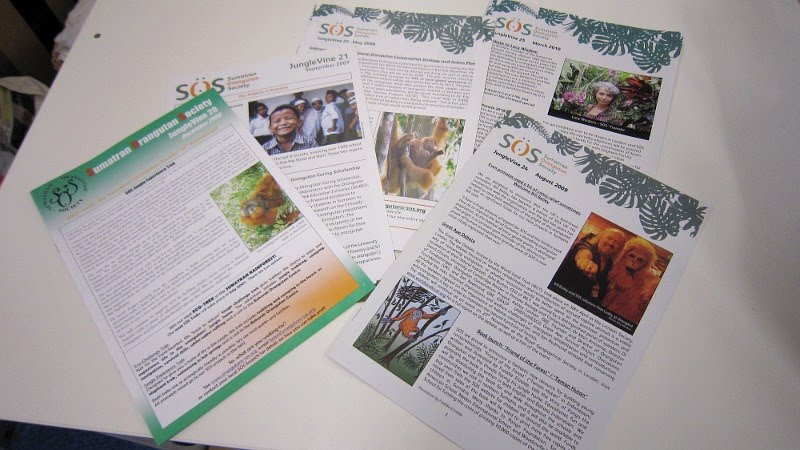
    Review of SOS newsletter JungleVine.

    After I finished reading the SOS newsletter JungleVine, issues 20-24 , I think that SOS is reaching the goals to communicate, raise public awareness and present accountability with SOS members and donors. As you can see the structure of the newsletter is divided into three parts, branch news about fundrasing and public awareness activities across UK, USA, Bali, Australia, New Zealand and Sweden, campaign and conservation news to catch up with the most critical conservation issues related to SOS'work, and project news from Sumatra for donors to know how their money was used to support conservation projects.

    It is very important to engage members or potential supporters with the charity's work with continuous news and achievements. For SOS,I think they have done a great job to use Web 2.0 media power like website portal, newsletters, blog, Facebook and Twitter to communicate with their members, donors and fans. This is what BCUA could learn and from which could be a model for us to reconstruct a Mandarin/ English bilingual portal website to manage our projects and satisfy our customers and audience.

    There are many interesting awareness activities which could be adopted in Taiwan like pedal power cinema (as mentioned in JungleVine 25), walk or run for orangutan (as mentioned in SOS Australia news of JungleVine 24), viewing orangutans in zoos (as mentioned in SOS Sweden news JungleVine 25) and brainstorming with kids to fundraise for orangutans or rainforest, competition for fundraising, and interaction amongst like-minded fans on facebook like "Harapan Parade" and "T-Shirt Design Competition" (the coming JungleVine 26 in October this year).

    What most impressed me is that the charity Patron is very popular and an ordinary scenario in UK. In Taiwan, it is difficult for small NGOs or charities to find patrons. A comedian Bill Bailey had held several big fundrasing events with other celebrities in London (as mentioned in JungleVine 23-25) for SOS, which is not bigger or more famous than the other four charities whose cause is orangutan conservation too.

    Many people in Taiwan probably will know the famous UK band called Bee Gees whose member Robin Gibb and his wife are patrons against breast cancer. This is another example to show you that famous faces will do a lot for charity.

    Try to visualize the content structure of JungleVine with XMind.

    Thanks to Helen Buckland who is SOS UK Director and had made a valuable revision for this article. :)